
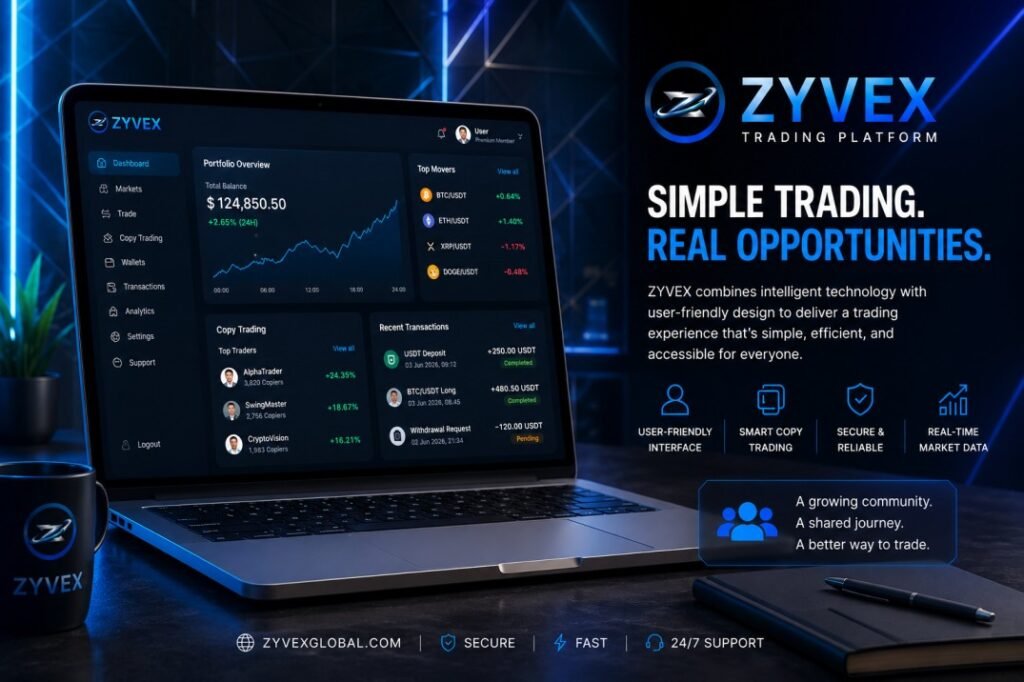
What the platform’s 2021–2026 trajectory reveals about the future of intelligent digital trading — and which bets are paying off
Five years ago, ZYVEX entered the digital trading market as an ambitious fintech startup with a thesis that was either prescient or naive, depending on who you asked at the time. The thesis was simple: the next generation of traders wouldn’t tolerate fragmented tools, slow execution, or platforms that treated intelligence as an afterthought. They would demand systems that think, adapt, and execute with precision — all in one place.
In 2026, that thesis doesn’t need defending anymore. The market validated it. The question now is whether ZYVEX has built a large enough competitive lead to hold its position as the technology it pioneered becomes the industry standard.
To answer that, it helps to look at what the company actually built during its first five years — and why the decisions it made early are determining the shape of its next chapter.
The Foundation Layer: Why 2021–2023 Was More Important Than It Looked
Most observers focused on fintech during the 2021–2023 period were watching the headline stories: the boom-and-bust cycle in crypto, the volatility spike in retail trading, the rapid consolidation among traditional brokerages rushing to compete with digital-native challengers.
ZYVEX was doing something less visible but more consequential: building infrastructure.
The platform’s early development centered on three capabilities that are now table stakes in digital trading but were genuine differentiators at the time. Real-time market analytics gave users live data visibility that most retail-focused platforms weren’t yet offering in a seamless, integrated form. Automated trading capabilities let users define and deploy strategies without the engineering overhead that had previously limited automation to institutional players with dedicated quant teams. And precision execution systems tackled a problem that most platforms either ignored or acknowledged but didn’t seriously address — the gap between where a trade is intended to execute and where it actually does.
Each of these capabilities represented significant engineering investment for a startup operating with the resource constraints of its early years. The decision to build all three simultaneously, rather than shipping quickly on one and adding the others later, defined the architecture of everything that followed. It also meant that by the time competitors began racing toward similar feature sets, ZYVEX had two years of production data, user feedback, and system refinement behind its implementations.
That lead is harder to quantify than a revenue figure, but it’s real. In technology, the difference between a feature that has been running in production for two years versus one that launched last quarter is enormous — in reliability, in edge case handling, in the quality of the data it generates, and in the team’s depth of understanding of how it actually behaves under real-world conditions.
The Security Investment: The Unsexy Competitive Advantage
In the years since launch, ZYVEX has made a consistent and visible commitment to security infrastructure — continuously upgrading its systems to protect user accounts and ensure operational stability across global markets.
This doesn’t generate headlines. Security announcements rarely do, unless they’re incident reports. But in the broader context of the digital trading industry, the ability to point to a multi-year record of zero major security incidents is more valuable than most companies publicly acknowledge.
Here’s why. The fintech sector has experienced a significant increase in sophisticated attacks targeting user accounts and platform infrastructure. High-profile incidents at competing platforms have demonstrated repeatedly that security failures don’t just create immediate financial harm — they permanently alter user trust calculus. Traders who move their accounts after a security incident rarely come back. The customer acquisition cost to replace them, in a competitive market, is substantial.
A clean security record accumulated over five years in an increasingly hostile threat environment is not luck. It reflects architectural decisions made at the foundation level — security designed into the system rather than layered on top of it — and ongoing investment in maintaining and improving those protections as the threat landscape evolves. For ZYVEX, that investment has quietly become one of its most defensible competitive assets.
The Inflection Point: Why 2026 Is Different From Every Previous Year
Every technology platform reaches an inflection point — a moment when the capabilities it has been building toward become technically viable to deploy, and the market is ready to absorb them. For ZYVEX, that inflection point appears to be now.
The AI and predictive analytics capabilities outlined in the company’s 2026 roadmap weren’t buildable in 2021 — at least not in the form they’re now possible. The models required weren’t mature enough. The infrastructure to run them at scale wasn’t economically viable. And critically, the data required to train them at the level of specificity that trading applications demand didn’t exist in sufficient depth.
All three of those conditions have changed. Large language models and machine learning architectures have advanced dramatically. Cloud infrastructure costs have fallen substantially, making AI-at-scale economically viable for platforms outside the top tier of institutional finance. And ZYVEX, after five years of processing market data across a growing user base, now has the proprietary data depth that gives its AI initiatives a foundation that a new entrant simply cannot replicate.
This is the strategic logic behind the timing of the announcement. The company isn’t pivoting to AI because it’s trendy. It’s deploying AI because the preconditions for doing it well — data depth, infrastructure maturity, organizational capability, and market readiness — have finally aligned.
Predictive analytics, in particular, represents the highest-value application of that convergence. The ability to generate probabilistic assessments of market direction from real-time and historical data — and to integrate those assessments directly into trading strategy execution — transforms what a platform can offer. It’s the difference between a highly capable reactive system and one that gives traders a genuine informational edge.
Getting this right is genuinely hard. The history of fintech is littered with platforms that announced AI capabilities and delivered sophisticated-sounding tools that didn’t actually improve outcomes in live trading conditions. The bar ZYVEX needs to clear isn’t demonstrating that its AI works in controlled conditions — it’s demonstrating that it works in the messy, non-stationary reality of live financial markets at scale.
The Scalability Question: Infrastructure as a Strategic Asset
One element of ZYVEX’s 2026 roadmap that deserves more attention than it typically receives in coverage of the anniversary is the investment in scalable infrastructure.
Trading platforms are among the most demanding infrastructure environments in commercial technology. Latency requirements are measured in milliseconds. Failure tolerance is near-zero during market hours. Volume spikes are unpredictable and can be extreme — a single macro event can generate transaction volumes that stress-test systems designed for normal operating conditions.
Building infrastructure that handles this reliably at current scale is hard. Building infrastructure that can absorb significant growth without performance degradation is harder. ZYVEX’s stated investment in scalable infrastructure signals that the company is planning for a substantially larger user base than it currently serves — and that it intends to handle that growth without the reliability incidents that have damaged competitors during periods of rapid expansion.
For traders evaluating platforms, infrastructure quality is one of the most important factors that’s also one of the hardest to assess from the outside. You only discover infrastructure limitations when they matter most — during high-volatility market conditions, during system stress events, during exactly the moments when platform reliability is most critical. ZYVEX’s track record of operational stability over five years, across multiple significant market volatility events, provides the most credible evidence available that the infrastructure has been built to hold up under pressure.
The Five-Year Assessment: What the Trajectory Actually Tells Us
Stepping back from the anniversary announcement, the most analytically useful way to evaluate ZYVEX’s five-year trajectory is to ask a single question: has the company consistently done what it said it would do?
The evidence suggests yes. The platform that exists in 2026 reflects the vision the company articulated in 2021, built out consistently and upgraded continuously. The technology capabilities delivered match the roadmap commitments made in prior years. The security track record reflects the commitment made publicly to protecting user accounts and platform integrity. The user experience evolution reflects the stated priority of making sophisticated tools accessible without sacrificing depth.
That consistency — between stated vision and executed reality — is the most important indicator of whether a company can be trusted to execute on ambitious future plans. In an industry where the gap between announcement and delivery is often wide, ZYVEX’s track record is a meaningful signal.
The roadmap ahead is more ambitious than anything the company has previously attempted. AI-powered predictive analytics, at scale, in live trading conditions, is a genuinely difficult technical and operational challenge. The company that clears that bar will have built something that the broader digital trading industry has not yet seen at accessible scale.
Five years of foundation-building was preparation for this moment. Whether the preparation was sufficient is the question that the next five years will answer — and for anyone watching the future of intelligent digital trading, it’s the most important question currently being asked in the sector.
ZYVEX has earned the right to attempt the answer. Now it has to deliver one.